
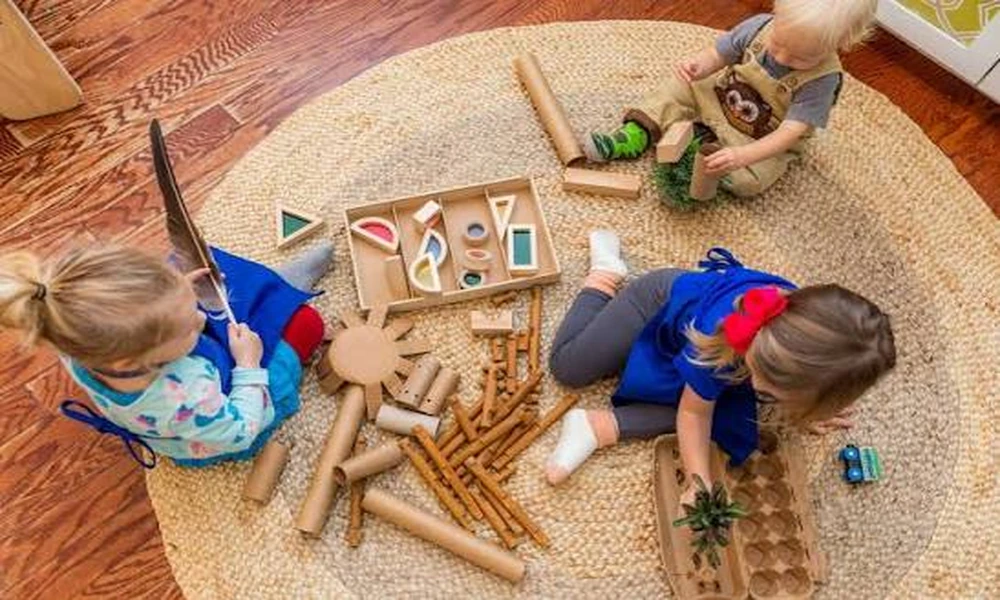
Learn how Reggio Emilia principles can guide your choice of open-ended toys, from child-led play to documenting what your child discovers.
Many parents notice the same pattern. A new toy arrives, holds attention for an afternoon, then sinks to the bottom of the toy box. Meanwhile, a cardboard box or a tin of pegs gets played with for weeks. The Reggio Emilia approach helps explain why, and it offers a practical way to choose play materials with more thought and less spending.
What ‘Reggio Emilia-Inspired’ Means at Home
The Reggio Emilia approach takes its name from a town in northern Italy, where families and educators began building new schools for young children after the Second World War. The educator Loris Malaguzzi became closely associated with the approach and helped shape its central idea: children are capable, curious people with their own theories about the world.
Malaguzzi wrote of the ‘hundred languages of children’. The phrase means that children express their thinking in many ways, including drawing, building, movement, music, clay and conversation, and adults should make room for all of them.
‘Reggio-inspired’ is a description, not a qualification. No toy carries an official Reggio stamp, and parents don’t need formal training to borrow the ideas. What matters most is how a material is offered and how adults respond to what children do with it.
Open-Ended vs Closed-Ended Materials: The Key Difference
Open-ended materials have no single correct use and no fixed end point. Blocks, fabric, clay, cardboard tubes, pebbles and wooden rings can become a road, a cake or a pattern, depending on the child and the day. Educators often call collections of small items like these ‘loose parts’: things that can be moved, sorted, stacked, combined and taken apart.
Closed-ended toys are designed around one outcome. A jigsaw has one solution. A button-press toy plays the same song each time. These toys have their place, and finishing a puzzle can be satisfying. The difference shows after the first success, when there is often little left to discover.
Open-ended materials invite play that changes as the child does. A two-year-old might fill and empty a tin of wooden pieces. A five-year-old might use the same pieces to build a zoo and explain who lives in each enclosure.
Five Questions to Ask Before Choosing a Toy
Use these questions in a shop, online or when sorting what you already own.
- Can it be used in more than one way? Try to name three different things your child could do with it. If you can’t get past one, it is probably closed-ended.
- Does the child lead the play, or does the toy? Toys that flash, talk or give instructions often decide what happens next. Quieter materials leave those decisions to the child.
- Does it invite the senses? Look for interesting texture, weight, sound, colour or the way it catches light. A smooth block, a crinkly scarf and a cool stone each offer something different.
- Can it combine with what you already own? Materials that work alongside blocks, figures, crayons or kitchen items add possibilities without adding much clutter.
- Is it durable, safe for your child’s age and easy to store within reach? Check age labels, watch for small parts with younger children and think about where it will live. A material your child can see and reach is more likely to be used.
A toy doesn’t need to pass all five. Treat the questions as a way to compare options rather than a strict test.
Sensory and Natural Materials as a Starting Point
Sensory exploration fits Reggio thinking because young children investigate the world through touch, sound, smell and movement as much as through words. Many good sensory materials are already at home: water in a basin with cups and funnels, uncooked rice in a tray, homemade playdough, fabric scraps of different weights, shells from a beach walk, leaves and offcuts of wood.
Purpose-made items such as textured balls, sensory bottles or light tables can add variety. If you want to see examples, the range of sensory play materials from CPS-Toys is one place to browse, and the five questions above apply there as anywhere else.
Supervision matters. Beads, beans, buttons and some shells can be choking hazards, especially for children who still put things in their mouths. Follow age guidance on packaging, stay close during small-parts play, and check natural objects for sharp edges first.
Following the Child’s Lead: Setting Up Invitations to Play
Reggio-inspired settings often use provocations, also called invitations to play. The idea is simple: arrange a few materials attractively and let the child decide what to do with them. A tray holding playdough, a few twigs and some buttons is an invitation. So is a mirror laid flat with a handful of coloured transparent shapes on top.
The approach describes the environment as the ‘third teacher’, alongside adults and other children. At home, the way a space is arranged shapes how children play in it. A few habits help:
- Keep shelves uncluttered, with a small number of materials in baskets or trays rather than heaped in a box.
- Rotate materials every week or two so returning items feel fresh.
- Resist demonstrating the ‘right’ use. If your child turns a set of cups into a drum kit, that is a discovery.
Stepping back can feel strange at first. Sitting nearby, or asking ‘What are you making?’, often supports play more than directing it.
Documenting Play to See What Your Child Is Learning
Documentation is the Reggio practice of recording what children do and say so adults can understand their thinking. Schools often display photos, transcripts and children’s work. At home it can be much lighter:
- Photograph a construction before it is tidied away.
- Write down something your child said while playing, in their own words.
- Keep a simple play journal or phone note with the date, the materials and a line about what happened.
- Look back at the records together. Children often enjoy explaining their earlier work.
Over a few weeks, patterns tend to appear. Your child may return to the same basket of fabric again and again, or ignore a new toy after two days. That record then guides future choices: more containers for a child who loves pouring, or different blocks for a child who builds every day.
Resources for Finding Open-Ended Materials
Open-ended materials don’t have to be new or expensive. Some places to look:
- Home and garden: containers, wooden spoons, fabric, cardboard, pegs, stones and leaves.
- Libraries and toy libraries: where available, these let families borrow materials before deciding whether to buy.
- Second-hand sources: thrift shops, community swap groups and hand-me-downs from friends.
- Retailers: CPS-Toys’ educational toy range is one retail option to browse alongside others.
Whatever the source, run each item through the five questions before it joins the shelf.
A Simple Place to Start
Start with one tray. Put out three or four materials your child can combine, step back, and take one photo or note by the end of the week. What your child does with that tray will tell you more about which materials suit them than any label on a box.